Narcan & Test Strips
In this section:
Harm Reduction at SJSU
All Spartans have a role in supporting our community’s health. You can play a critical role in reducing harm associated with substance use through the application of harm reduction strategies.
Harm Reduction is a compassionate approach that promotes safer use, prevents overdose, and saves lives. It provides non-judgmental, low-barrier tools to reduce drug-related harm and support recovery by meeting people where they are. By reducing stigma, harm reduction helps individuals access treatment, mental health care, and other supportive services.
Language Matters! Using non-stigmatizing language when talking about substance use creates a safe, judgement-free, and recovery supportive community. For additional information on stigma and substance use language, see this Language Guide [pdf].
Harm Reduction Resources
Opioid Overdose Prevention
Naloxone (Narcan)
Naloxone, also known as Narcan Nasal Spray, is an opioid overdose reversal medication to prevent opioid-related death. Narcan is available through the Student Wellness Center for all members of the SJSU community. To receive Narcan at no cost from SJSU, students, staff, and faculty can pick up Narcan in the Wellness Lounge during normal business hours (Monday-Thursday: 10:00 a.m. - 4:00 p.m.; Friday: 1:00 p.m. - 4:00 p.m.).
Naloxone is also available for free through:
Santa Clara County’s Harm Reduction Program and Naloxone by Mail resource
View this quick video tutorial on how to use Narcan:
We also encourage students, staff, and faculty to view the SJSU Narcan Distribution Program training that provides additional Opioid Overdose Prevention education.
Frequently Asked Questions
What is Naloxone/Narcan?
Naloxone is a non-addictive medication used for known or suspected opioid overdoses. It is an opioid antagonist (blocker) that stops opioids from binding to the opioid receptors in the brain, thus countering the effects of opioid overdose. Common opioids include heroin, fentanyl, morphine, codeine and oxycodone.
Naloxone is available in the form of a prepackaged nasal spray (commonly known by the brand name Narcan).
Who should consider obtaining Narcan?
If you or a loved one have an opioid prescription, or are struggling with opioid use, you can consider obtaining Narcan to keep on hand.
Anyone obtaining any illicit substance (e.g., prescription medication purchased from the internet), may also consider keeping Narcan on hand. There has been an increase in substances laced with fentanyl, and individuals using these substances can unknowingly suffer from an opioid overdose.
Carrying Narcan or having it on hand provides an extra layer of protection for those at a higher risk for overdose.
Does Narcan have any side effects?
There are little to no side effects associated with Narcan. It is important to note however that individuals who are physically dependent on opioids can experience withdrawal symptoms after Narcan is administered. Withdrawal symptoms may include fever, anxiety, irritability, rapid heart rate, sweating, nausea, vomiting, and tremors.
Can I use Narcan on myself?
No, narcan is administered to an individual after an overdose has occurred. Because the individual who overdosed is likely unconscious and/or their movement and breathing may be restricted, they would need assistance. If you have no one around you, use the Never Use Alone Hotline.
Who can obtain Narcan through SJSU’s Narcan Distribution Program?
This product is only available to members of the SJSU community, this means SJSU students, staff, and faculty.
Santa Clara County residents that are not part of the SJSU community can obtain narcan at no cost through Santa Clara County’s Sexual Health and Harm Reduction Program. Please visit their website to learn about locations and hours in which you can pick up the product.
Where else can I get Narcan?
In addition to the Student Wellness Center, Narcan can also be obtained at no cost through Santa Clara County’s Sexual Health and Harm Reduction Program. Visit the program’s website to learn more.
Narcan can also be purchased through the Student Wellness Center Pharmacy and local pharmacies.
For anyone outside of Santa Clara County, visit the National Harm Reduction Coalition to learn about harm reduction resources near you.
What is SB 367?
Senate Bill (SB) 367, known as the Campus Opioid Safety Act is a policy within the state of California that requires college campuses to provide educational and preventative information about opioid overdose, information about the use and location of reversal medication such as Narcan, and to participate in the Department of Health Care Services' Naloxone Distribution Program.
Fentanyl Test Strips
- Fentanyl test strips are available through the Student Wellness Center for all members of the SJSU community. The test strips are free and can be picked up in the Wellness Lounge during normal business hours (Monday-Thursday: 10am-4pm; Friday: 1pm-4pm).
- Test strips are also available for free through:
- Santa Clara County’s Sexual Health and Harm Reduction Program. Please visit their website to learn more.
- Santa Clara County’s Q Corner. Visit their website to learn more.
- Santa Clara County’s Sexual Health and Harm Reduction Program. Please visit their website to learn more.
- Test strips can also be purchased through reputable online and at your local pharmacy.
Frequently Asked Questions
What are fentanyl test strips?
Fentanyl test strips are a tool that can be used to help prevent drug overdoses and reduce harm, by detecting the presence of fentanyl in all different kinds of drugs (cocaine, methamphetamine, heroin, etc.) and drug forms (pills, powder, and injectables). Please note, while fentanyl test strips are a helpful tool to reduce the harm of consuming fentanyl laced substances, they do not guarantee that the substance being consumed is completely fentanyl-free.
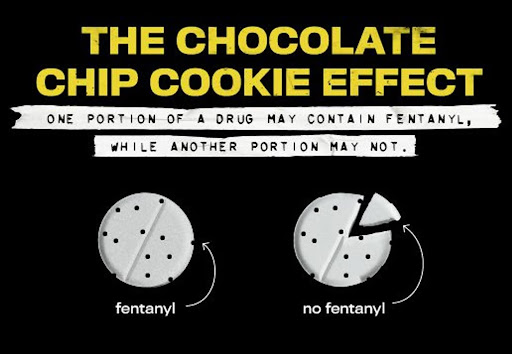
Take a look at the graphic below from the Centers for Disease Control and Prevention - testing your substances with fentanyl test strips is like a chocolate chip cookie - depending on where you bite, there will be different amounts of chocolate chips and no two chocolate chip cookies are exactly the same. Similarly, when you test part of a substance with a fentanyl test strip, that particular section that you tested may not have any fentanyl, but that does not mean other sections will also be fentanyl-free.
How do I use fentanyl test strips?
There are various brands of test strips and each one is a little different; be sure to follow the instructions provided by the manufacturer in order to read the test correctly.
In general though, test strips will require you to put a small amount of the drug in a container, add water, mix, insert the strip, wait a short amount of time, and then read the results.
When reading the results:
If you receive a positive result, it is safer to discard the batch. Fentanyl is a potent substance and usage can result in an overdose
If you receive a negative result, proceed with caution. No test is 100% accurate and your drugs may still contain fentanyl (remember the chocolate chip cookie effect).
If you get an invalid result, test your drugs again using a new strip.
Where can I obtain fentanyl test strips?
A limited stock of fentanyl test strips are available through the Student Wellness Center for all members of the SJSU community. The test strips are free and can be picked up in the Wellness Lounge during normal business hours (Monday-Thursday: 10am-4pm; Friday: 1pm-4pm).
Test strips are also available for free through:
Santa Clara County’s Sexual Health and Harm Reduction Program. Please visit their website to learn more.
Santa Clara County’s Q-Corner. Visit their website to learn more.
Test strips can also be purchased through reputable online and at your local pharmacy.
Lowering the risk of overdose
In addition to using fentanyl test strips, below are other ways to lower your risk of overdose and keep you and others safe:
Keep naloxone readily available on you and at home.
Avoid mixing drugs.
Don’t rely on a previous source or experience, each batch is not guaranteed to be identical.
Never use drugs alone. Make sure the people around you are aware when you have used a substance in case they need to give you naloxone or call for emergency assistance. If you have no one around you, use the Never Use Alone Hotline.
It’s okay to ask for help.
What is AB 461?
Assemble Bill (AB) 461, is a policy within the state of California that requires college campuses to provide educational and preventative information about opioid overdose and information about the use and location of fentanyl test strips and opioid reversal medication to students.
Alcohol Safety
Drink Spike Tests
Drink spike test strips are available through the Student Wellness Center for all members of the SJSU community. The test strips are free and can be picked up in the Wellness Lounge during normal business hours (Monday-Thursday: 10am-4pm; Friday: 1pm-4pm). For additional alcohol-related resources, visit Alcohol and Other Drugs.
Frequently Asked Questions
What drugs do the test strips test for?
Test strips will detect Ketamine, GHB, Scopolamine, Cocaine, and other “amine” based drugs.
How do I know if my drink was spiked?
Salty or bitter taste
Foggy/cloudy appearance of drink when it was clear before
Excessive bubble, especially if the drink was non-carbonated
Change in color of the drink’s original color
What to do if I think my drink was spiked
If your drink’s physical appearance seems “off” or you have a strange feeling about the drink, do not drink it and pour the drink out. In the event of an emergency, call 911 to receive care.How would I feel if my drink was spiked?
Feeling “out of it” or drunker than expected
Confused, woozy or drowsy
Speech difficulties
Memory loss
Loss of inhibitions
Nausea and vomiting
Loss of consciousness
A severe hangover when you drank little or no alcohol
How can I prevent drink spiking?
Don’t accept drinks from others
Watch your drink being made or open your drink yourself
Be cautious of drinks in large containers or punch bowls
Don’t drink anything that looks or smells strange
Wipe off rim of opened drinks or glasses before drinking
Leave with the people you went out with and have a designated “sober” person in the group
What is AB 1524?
Assembly Bill (AB) 1524 is a policy within the state of California that requires college campuses to provide drug testing devices (test strips) for students.
Resources
If you or someone you know if struggling with a substance use disorder, and you would like to learn more about treatment and referral services, check out the following resources:
- SAMHSA National Helpline: 1-800-662-HELP (4357)
- Santa Clara County’s Sexual Health and Harm Reduction Program
- Santa Clara County Q Corner
- Harm Reduction Coalition
- Santa Clara County Overdose Prevention
- If you need someone to talk to on campus, schedule an appointment with a counselor at the Student Wellness Center by calling (408) 924-5678